%20(1)%20(1)%20(1)%20(1).png)
Controller Services: Accounting's Next Growth Engine
Updated: 1 day ago

Findings from the Riskrate market study of accounting firms, June–July 2026.
Accounting firms want to sell deeper advisory work. What most of them are missing is not the ambition or the expertise; it is a way to produce the work, client after client, without adding an hour of manual analysis to every engagement.
That is the short version of what we heard when we asked accounting firms about controller and advisory services in a market study run between June and July 2026. We asked about their growth plans, the obstacles in the way, the tools they actually want, and where they would like support.
The findings below are reported at the level of direction and priority rather than exact figures. The individual responses stay with the firms that gave them.
1. Controller services are a deliberate growth direction
A clear majority of the firms we surveyed intend to grow their controller and advisory revenue over the next twelve months. For the largest group, the goal is significant growth, a real shift in the revenue mix, not a modest add-on to compliance work.
That matters, because it changes the nature of the problem. Selling one advisory engagement is a sales question. Growing advisory revenue across a whole client base is a production question: can the firm deliver consistent, high-quality analysis to a hundred clients with the people it already has?

2. The biggest need is supporting the controller's work
When we asked which capabilities of an AI-assisted controller would help most, two answers came out on top by a wide margin:
Ready-made findings and talking points to take into the client meeting
Analyses and forecasts prepared in advance, so the expert reviews rather than builds
Automating valuation, analysis and reporting followed closely behind, along with visibility into which clients, products and services are actually profitable.
The most interesting result was at the bottom of the list. Self-service AI aimed at the end client ranked last. Firms are not looking for something to hand over to their clients; they want leverage for the professional who sits across the table from them. The relationship stays with the firm. The preparation is what should get faster.

3. Clients have moved past the historical numbers
In the open responses, one theme dominated: clients are asking for forward-looking work. Budgeting and forecasting came up most often, followed by cash-flow visibility, financial and business analysis, and strategic advisory and, increasingly, ESG reporting.
In other words, clients want the part of the work that has always been the hardest to scale. A set of monthly figures can be produced systematically. An interpretation of those figures, a forecast built on them, and a recommendation drawn from both have traditionally required a senior person and several hours per client.
Several respondents also named a subtler obstacle: identifying which clients need which service in the first place. The demand exists, but it is not always visible from inside the ledger.

4. One concrete finding is what starts the conversation
We asked which single observation would be most likely to make a business owner stop and think, this is genuinely useful to us. The answers had a clear pattern. Abstract dashboards did not win. Specific, monetised findings did.
Three types stood out:
When the result moves, the value of the company moves. Showing an owner what this year's result did to what the business is worth reframes a profitability discussion as a wealth discussion.
What one product or service actually costs to deliver. Almost every firm that runs this analysis finds something being sold below the cost of producing it.
Where margin can be recovered, and how. Not an observation, but a proposal: the specific change, its expected effect, and a date to review it.
This is also the practical answer to the visibility problem in the previous section. A single, well-framed finding is what opens the door to a paid advisory relationship; it demonstrates value before anyone has to sell anything.

5. The gap is the conversation, not the technique
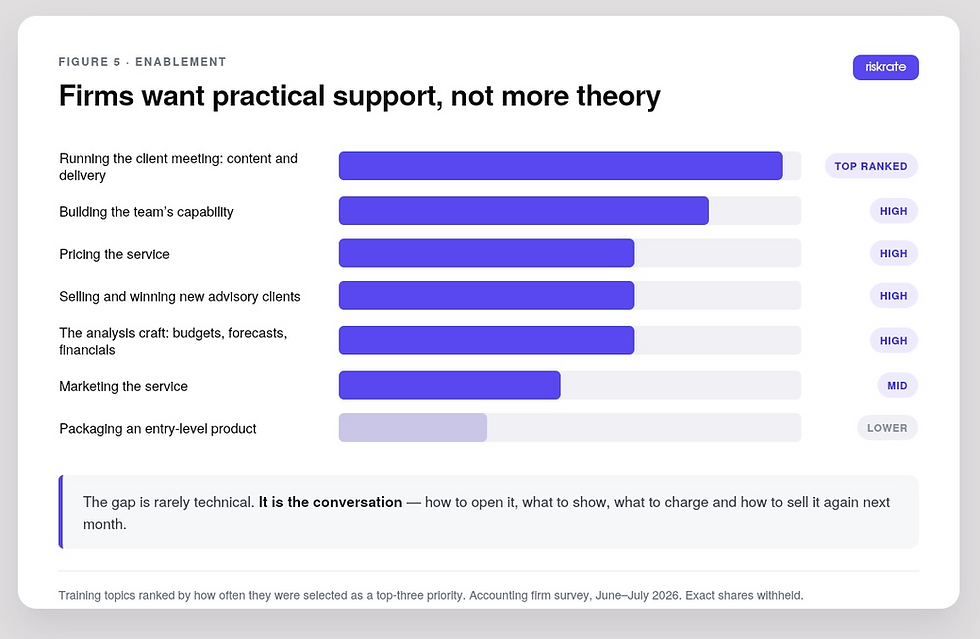
Finally, we asked where firms would want training and practical support. The top answer was the client meeting itself: what to put in it, how to run it, and how to land the recommendation. Building team capability came next, followed by pricing the service, selling it, and the analysis craft itself.
The pattern is consistent with everything above. The financial competence is already in the building. What firms are asking for is the operating model around it, how to package the service, what to charge, how to present it, and how to repeat that reliably across a client base.
What this means for the industry
Put the findings together, and the picture is coherent. The accounting sector is moving toward higher-value expert services, and the firms leading that move have already decided to. The constraint is production capacity: turning financial data into usable insight quickly enough, and cheaply enough, that advisory work can be offered to every client rather than the largest ten.
That constraint is exactly what technology should be solving, not by replacing the advisor, and not by handing an AI tool to the end client, but by having the analysis, the forecast, and the first draft of the recommendation ready before the meeting starts.
How Riskrate fits

Riskrate builds the controller layer accounting firms said they wanted. Financial (client, invoicing, and CRM) data goes in; what comes out is a client-ready analysis: the findings worth raising, the valuation impact, the forecast, and a concrete proposed next step: prepared automatically, reviewed by your expert, and delivered under your firm's own brand.
Alongside the product, we work with firms on the parts they told us matter most: productising the service, pricing it, and running the client meeting that turns an analysis into an engagement.
Interested in what this would look like with your own client base? Get in touch, and we will walk you through a sample controller analysis, built on real financials.
Riskrate market study, accounting firms, June–July 2026. Results are reported as directional findings; individual responses and exact figures are not published.


